What Is AI Asking of Us?
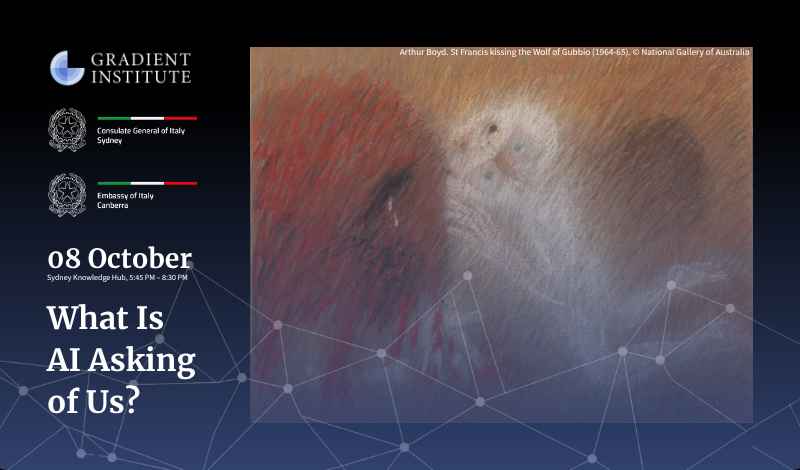
Thursday 8 October 2026, 5:45 pm - 8 pm · Sydney Knowledge Hub, Merewether Building, The University of Sydney
Convened by Gradient Institute, in partnership with the Embassy of Italy Canberra and the Consulate General of Italy Sydney, during the Australian visit of Fr Paolo Benanti “St Francis and The Artificial Wolf.”
Registration required. Register here.
Father Paolo Benanti, theologian, moral philosopher and AI ethicist, advisor to the Holy See, the UN and the Italian Parliament on AI Ethics and governance, visits Australia on the occasion of the 800th anniversary of the death of St. Francis. He will take part in talks and gatherings across different Australian cities on the theme of "St Francis and the Artificial Wolf."
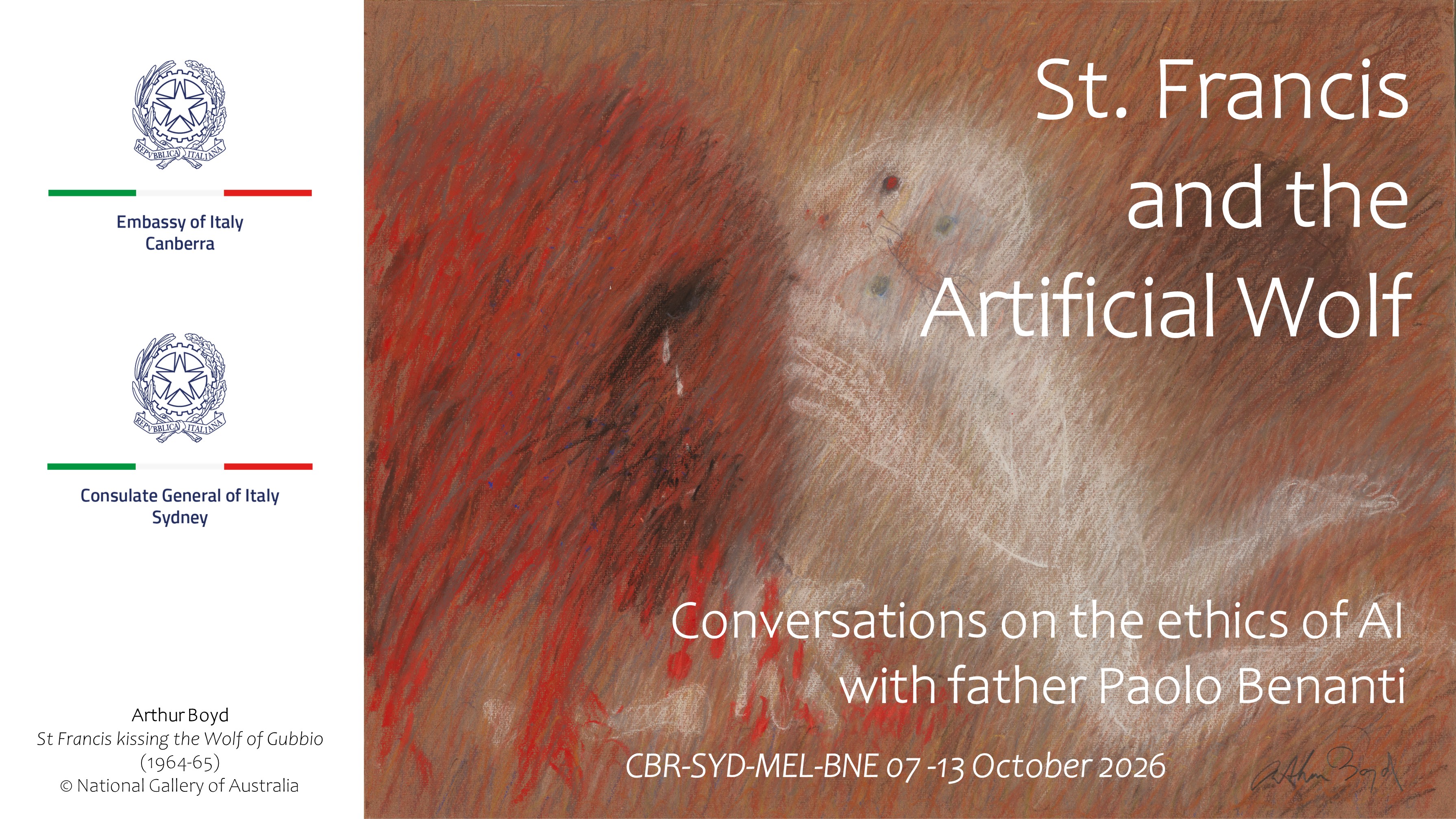
The tour takes its name from the legend of Gubbio. A wolf terrorises a town; Francis walks out to meet it, and he brings back a pact. The wolf's violence, he says, came from hunger, so the townspeople agree to feed it for the rest of its life, and the wolf agrees to stop killing. Both sides change by taking on an obligation.
That is a story that invites a deeper reflection than what we usually hear about technology. We're glad to host Fr Benanti in Sydney at our next Gradient Gathering to explore what a pact with today's artificial wolf would require of us now.
The evening
When registering, everyone tells us, in their own words, what they think about the ethical development and use of AI. We ask this of everyone in advance of the event, because we want the evening to begin with what you feel it’s worth surfacing.
Reading the replies so far, what comes through clearly is a great deal of care alongside a real sense of unease.
People wrote about the dignity of their work, about what their children should be learning, about whether they still understand the decisions being made around them, about who is being left out, and about a pace of change that existing institutions weren’t built to absorb. People are paying close attention to what matters, to them and to others, but don’t yet know how to best respond.
So we have designed this evening as an inquiry: a chance to look at this moment together, steadily and without hurry, and to ask what it still leaves us free to do, for ourselves and for one another.
The direction
AI is pressing on long-held ideas about what a human being is and what a human life is for: what work is for, what learning is for, what it means to decide, to pay attention, to create, to be answerable for something. Which of those pressures should we resist? Which should we welcome?
Each speaker is given the same question, and seven minutes to explore it:
AI is pressing on long-held ideas about what a human being is, and what a human life is for. From where you stand: what is AI asking of us, and how do we want to answer?
A facilitated conversation among the speakers follows, and then we open the floor to questions from the room.
The conversation
Fr Benanti will be joined by three distinguished guest speakers, each of whom has thought carefully about the relationship between humans and AI, and each of whom comes to the question from a different background:
Father Paolo Benanti is a Franciscan friar and theologian, Professor at the Pontifical Gregorian University and Associate Professor of Moral Philosophy at LUISS in Rome. He sits on the United Nations High-Level Advisory Body on Artificial Intelligence, has advised Pope Francis on AI and technology ethics, and is President of the Ethics Committee of the Observatory on Artificial Intelligence established under the EU AI Act.
Dr Simon Longstaff AO began his working life on Groote Eylandt in the Northern Territory of Australia. He is proud of his kinship ties to the Anindilyakwa people. After a period studying law in Sydney and teaching in Tasmania, he pursued postgraduate studies as a Member of Magdalene College, Cambridge. In 1991, Simon commenced his work as the first Executive Director of The Ethics Centre, a position he holds to this day. Simon is also an Adjunct Professor of the Australian Graduate School of Management at UNSW, a Fellow of CPA Australia, the Royal Society of NSW and the Australian Risk Policy Institute.
Venerable Associate Professor Juewei began in computer science and engineering at the University of Michigan. She has an MBA from Cranfield. She was ordained in the Fo Guang Shan order in 2002, and took a PhD in Religious Studies at the University of the West, Los Angeles. Today she heads the Applied Buddhist Studies and Humanistic Buddhism program at Nan Tien Institute and directs its Humanistic Buddhism Centre, where she has led research on Humanistic Buddhism, especially foregrounding wellbeing, social trust, and ethical responsibility in digital systems. Recently, she led a submission to the UN Commission on Science and Technology for Development on Buddhist data principles.
Anna Goldsworthy is a pianist and writer, Dean of the Elder Conservatorium of Music and School of Performing Arts at Adelaide University, incoming Artistic Director of the Australian National Academy of Music, and the author of Piano Lessons, Welcome to Your New Life, and Melting Moments. She authored this year's June Quarterly Essay, The God We Made: The Threat and Promise of Artificial Intelligence, where she argued that AI is a rupture that makes us confront what it is to be human.
Hosted by Alberto Chierici and Tiberio Caetano, Gradient Institute.
Schedule
Doors 5.45 pm · program 6.20–8.00 pm · drinks until 8.30 pm. One hundred guests cap.
Free, with registration required at this link.